
Passive Pt100
For an existing RTD input
Four-wire resistance measurement. No transmitter supply. Best when the controller already accepts Pt100 and the complete cable is wired for four-wire sensing.
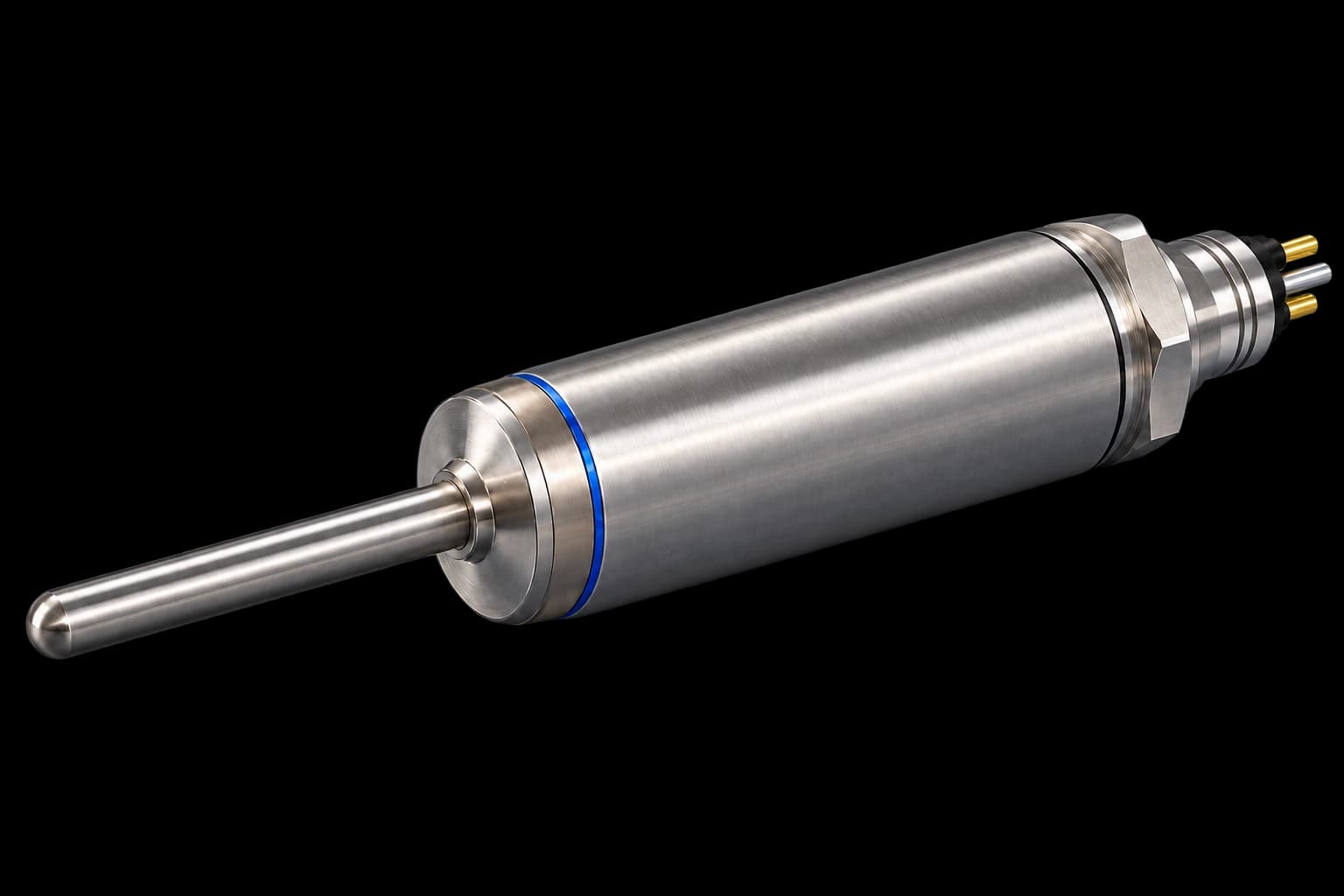
A compact immersion temperature sensor for subsea equipment, cooling circuits and the surrounding water. A platinum sensing element sits inside a slender metal probe, with a Micro circular subsea connector mounted directly on the rear of the housing.
Custom mounting, materials and supporting cable assemblies.
Choose the output around the equipment receiving the signal. The probe measures local temperature; its mounting, immersion and water flow determine how closely that represents the temperature you need.
For an existing RTD input
Four-wire resistance measurement. No transmitter supply. Best when the controller already accepts Pt100 and the complete cable is wired for four-wire sensing.
For a PLC or subsea input module
Two-wire, loop-powered temperature signal. Factory-scaled measurement span. A practical starting point for controls and longer cable assemblies.
For vehicle electronics and logging
Powered digital temperature output for vehicle electronics and logging. Confirm the protocol, register map and update rate with your control system.
Heat transfers through the closed metal probe to the platinum element.
The element’s resistance changes with temperature; a suitable input or internal transmitter converts it.
The rear Micro connector carries the RTD wiring, current loop or digital signal to the control system.
Measure inlet and return water temperatures to track cooling performance. Use matched, calibrated sensors when temperature difference matters.
Feed water or equipment-fluid temperature into local electronics through a removable subsea cable assembly.
Monitor surrounding water near submerged lifts, gates and actuators. Mount clear of heat sources unless their temperature is the intended measurement.
DL-T-A-050-TI-MC-M
Series – output – measurement range – housing – connector. Custom probe or mounting details are recorded on the configuration drawing.
| Option | Code | Selection |
|---|---|---|
| Output | R / A / D | Pt100 / 4–20 mA / RS-485 |
| Temperature span | 050 / N0260 | 0–50 °C / −2–60 °C |
| Housing | TI / SS | Titanium / 316L |
| Connector | MC-M | Rear-mounted metal-bodied Micro male |
| Probe & mounting | Drawing suffix | Immersion length and mounting agreed by drawing |
The range code identifies the measurement span, not a certified housing depth rating. The MC-M code identifies the rear Micro male interface; contact allocation and mating connector reference are included in the configuration drawing.
An immersion probe measures its own local temperature. In water, it should track the surrounding fluid once stabilised. Surface or internal-equipment measurements require a different mounting arrangement.
A current-loop transmitter connects directly to common analogue inputs. Passive Pt100 is appropriate when a suitable RTD input is already available. Four-wire connection compensates for lead resistance but does not remove every installation error.
A higher-temperature sensing element does not automatically give the complete subsea assembly the same temperature rating. Hotter fluids would need a separate probe, thermal-isolation and connector review.
| Series | DL-T |
|---|---|
| Supply | Available to order — configured to suit your application |
| Measurement | Pt100 platinum RTD immersion temperature |
| Output options | 4-wire Pt100 / 2-wire 4–20 mA / RS-485 |
| Range options | 0 to +50 °C / −2 to +60 °C measurement spans |
| Housing options | Titanium / 316L stainless steel |
| Connector | Direct rear-mounted metal-bodied Micro male; mating cable supplied separately |
| Mounting | Probe immersion length, clamp or collar to suit the installation |
| Configuration documentation | Dimensions, pin allocation, supply voltage, calibrated accuracy and operating limits specified with your quotation |
| Submersion duty | Specify working depth and water conditions; the complete assembly pressure rating is selected for the application |
DL-T-R-050-TI-MC-M
4-wire Pt100 · 050 · Titanium · Rear Micro male
DL-T-R-050-SS-MC-M
4-wire Pt100 · 050 · 316L stainless steel · Rear Micro male
DL-T-R-N0260-TI-MC-M
4-wire Pt100 · N0260 · Titanium · Rear Micro male
DL-T-R-N0260-SS-MC-M
4-wire Pt100 · N0260 · 316L stainless steel · Rear Micro male
DL-T-A-050-TI-MC-M
4–20 mA · 050 · Titanium · Rear Micro male
DL-T-A-050-SS-MC-M
4–20 mA · 050 · 316L stainless steel · Rear Micro male
DL-T-A-N0260-TI-MC-M
4–20 mA · N0260 · Titanium · Rear Micro male
DL-T-A-N0260-SS-MC-M
4–20 mA · N0260 · 316L stainless steel · Rear Micro male
DL-T-D-050-TI-MC-M
RS-485 · 050 · Titanium · Rear Micro male
DL-T-D-050-SS-MC-M
RS-485 · 050 · 316L stainless steel · Rear Micro male
DL-T-D-N0260-TI-MC-M
RS-485 · N0260 · Titanium · Rear Micro male
DL-T-D-N0260-SS-MC-M
RS-485 · N0260 · 316L stainless steel · Rear Micro male
Send your measurement range, output, working depth, mounting requirements and cable length. We’ll confirm the configuration, price and lead time.